

• Skip to primary navigation
  • Skip to main content
  • Skip to footer
Greentarget

Greentarget

  • Our Culture
    • How We Work
    • Vision & Values
    • Diversity, Equity, Inclusion and Belonging
    • Careers
      • Internships
  • Industries
    • Professional Services
    • Legal
    • Accounting
    • Commercial Real Estate
    • Financial Services
    • Management Consulting
  • Services
    • Earned Media Influence
    • Research & Market Intelligence
    • Content & Editorial
    • Digital Strategy
    • Crisis Communications
    • Executive Positioning
  • Insights
  • Our Manifesto
  • About Us
    • Meet the Team
    • Awards
    • Contact Us
  • Connect

Professional Services

February 2, 2021 by Joe Eichner

Too many of today’s aspiring thought leaders are more concerned with simply being part of the conversation than adding to it in a meaningful way.

There can be a lot of reasons for this. Often it’s a feeling that they have to keep pace with competitors – the marketing equivalent of FOMO – even if they don’t have anything new to say. Other times, thought leaders have a lot to say, but are afraid their perspective could offend someone, somewhere, and cost them business.

It’s a problem because in almost every case it strips the would-be thought leadership of a point of view – which we believe is essential for establishing authority.

Here’s what aspiring authorities need to know.

Defining POV in the professional services context

The clearest and most succinct definition of point of view that I’ve ever come across is this: a point of view is a statement that others might disagree with.

Consider that a point of view is (by definition) not a statement of fact. Like any good piece of writing, or any good dinner guest, a solid POV should incite further conversation rather than close it off by simply repeating what’s already been said, stating the obvious or saying something patently false or outrageous. A point of view, like those thesis statements we learned about in middle school, suggests a well-constructed argument – and the best arguments are typically those that persuade, excite, or push the conversation forward using hard facts, engaging writing and illustrative examples.

Marketers at professional services firms might say, “Well yes, this is all well and good in theory, but the consensus-driven partnership structure of my organization makes it difficult to actually achieve.” And of course they’re right. It’s rare to find a lawyer or consultant who really wants to go out on a limb and risk offending their partners, clients or potential clients. The rub is that this is often what makes the best point of view – just look at any newspaper’s most read op-ed pieces.

And yet there is a middle ground here. Just because someone might disagree with a point of view doesn’t mean it has to be controversial or combative. For instance, it might simply be, “You’d do it this way? Interesting. Here’s why I think you should do it this way instead…”

Alternatively, sometimes a compelling, subjective point of view shines through the voice and distinct personality of the writer. Most movie critics, for instance, fawned over Moonlight (see: a 98% rating on Rotten Tomatoes). But the lack of dissension doesn’t render each critic’s review moot. That’s because good critics express that same opinion in new and unique ways – through their individual experiences, interesting historical and industry context, their personal prose style – that set each review apart and opens up more space for conversation and disagreement.

Similarly, a consultant could agree that we need more focus on environmental, social and governance considerations at the board level (at this point, who doesn’t?). But they may also disagree on the best ways to go about it – or simply have different priorities. They may view it through the lens of, say, the consultant’s stint in South Africa during apartheid, or in advising directors who were early ESG adopters. Nobody needs to hear another call to adopt ESG. But drawing on unique experiences could help make the case for ESG in a way that nobody else has.

All of which brings me to another definition, one perhaps more palatable to professional services firms: a point of view is a statement that is made more compelling by virtue of the author’s unique perspective.

How to find your professional services firm’s POV in 4 steps

Crafting a quality POV takes work. Namely – and this is what most would-be thought leaders elide – what you want to say is only one part of the puzzle. You also need to understand what’s already been said about the topic and what your audience wants to hear about the topic. Only then can you figure out what you (and ideally only you!) can bring to the table.

Ask yourself, or the would-be thought leader you’re working with, these four questions to get there:

1) Can you frame the topic as a “how” or “why” question?

This question should articulate a pain point of a particular audience, e.g., “How should corporate leaders maintain their culture when everyone’s working from home?”

Forcing yourself to frame your topic this way not only directs your content towards an audience need, but does so in a way which pushes past the simple “what” (i.e., the information anyone could find on Wikipedia or a news site) and into the more meaty terrain of “why” or “how.”

2) What has been – and is being – said about the topic you want to write about?

Think of this as an audit of the current conversation. If your objective is to add to that conversation meaningfully, you have to know what’s been said so that you don’t merely repeat what everyone already knows.

Remember, this is the first step in an iterative process. It’s possible that you’ll start out thinking you have a unique POV, only to find three people have already said the same thing. So keep digging. Sometimes the solution is to think smaller and find a narrower, more specific angle (or audience); in other words, to do more with less rather than less with more. Other times, you might find an existing POV that you disagree with, which can act as a springboard for your own (“Numerous folks have said X…but I believe that Y is the right answer…”). And other times the solution will come from how you, specifically, can address the issue.

This step is where research (and a partner like Greentarget…hint, hint) can play an important role, be it by assessing media narratives, analyzing keyword search patterns or surveying audiences to get a more accurate picture of their views and concerns.

3) What does your desired audience need and/or want to hear about this topic?

Put yourself in your audience’s shoes: What’s keeping them up at night when it comes to this issue? What don’t they know that they should be prepared for? How can you illustrate this in a way that will grab their attention (i.e. with specific examples, anecdotes, statistics, etc.)? And, perhaps most importantly, why do they need to know this right now?

In our research, we’ve found that when it comes to thought leadership content, utility is what attracts C-suite executives to content more than any other attribute. Utility disrupts the professional services sales cycle by answering the question “what do I need to do to navigate or address this issue today?” Ideally, it provides the answer before the audience has asked it. It empowers audiences to act by tipping the scales from passive consumer to engaged prospect. With utility, authorities will be heeded. Without utility, it’s all just talk. More talk means more noise.

4) Why should you be the one to write this?

Once you’ve assessed the current conversation and your audience’s needs, you’ll be in a good position to figure out what you can uniquely add to the conversation. Here the (admittedly aspirational) test for good thought leadership might be: Could someone else have written his?

Of course, it’s unrealistic to think that you are, say, the only accountant that can dish insights around the complexities of PPP loan forgiveness. But that’s where your personal voice and experience – attributes that no one else has – comes in. This can be professionally related, sure, but it can also be more personal: Can you connect this to something you’ve experienced? Some other industry or news trend you’re following? A hobby of yours? A client you’ve assisted in the past?

At the end of all this, hopefully you’ll have something that doesn’t just add to the noise – but contributes to a smarter conversation.

December 18, 2020 by Greentarget

Companies across the country are investing in data and how to harness it, yet some continue to struggle with using that data to tell their story. That means they’re missing the opportunity to create transparency within their organization and, most notably, the chance to exercise their authority through the contextual awareness their data can bring.

In this episode, host Aaron Schoenherr and Narrative Science President Nick Beil discuss going beyond the dashboard and into data, the relationship between transparency and authority and data overload in the age of COVID.

Episode Highlights

1:17 – Nick provides his background and introduces his company, Narrative Science. 

2:32 – Nick discusses if hard data or the stories behind those numbers carries more authority. 

4:10 – An in-depth example of how contextual data is more powerful than data on its own, particularly within the COVID-19 pandemic.

8:09 – Analysis of how busy executives prefer to receive their data.

10:25 – Aaron and Nick discuss the relationship between transparency and authority, and the role trust plays.

14:00 – Nick gives examples of industries that are ahead of the curve with their data strategy and highlights which industries are lagging.  

16:55 – Nick provides insight into how he gets organizations that are behind the curve to reconsider their data strategy.

19:02 – Discussion about potential data overload amid the COVID-19 pandemic. 

20:50 – Aaron and Nick discuss organizations and leaders who have demonstrated true authority during the pandemic.

Subscribe to Authority Figures on Apple Podcasts or wherever you get your podcasts.

December 10, 2020 by Greentarget

The professional services marketer who sets out to develop a content strategy is likely to find the process frustrating, the execution lackluster and the results disappointing.

The process of creating a content strategy can be a nightmare in consensus-driven partnerships. Strategy requires setting limits, which can invite the fury of practice groups that aren’t identified as priorities. Most law firm leaders aren’t going to go there. Marketers who do manage to create a strategy are likely to find strategic elements like governance and promotional schedules completely ineffectual when dealing with partners and their impenetrable calendars.

Instead of putting yourself through that agony, try stripping your content strategy down to the essentials. Create a basic, realistic plan to produce content with strategic value – and put your energy and resources into content that establishes the firm’s authority and ultimately helps it win new business.

Four Elements of a Better Professional Services Content Strategy

A plan with the following four elements represents a strong framework for most professional services firms:

  • Authorities: Which subject matter experts you want to amplify
  • Audiences: Who your authorities are trying to influence – and what they need to know
  • Formats: Client alerts, bylines, LinkedIn posts – whatever will be the most effective vehicle engaging those audiences
  • Schedule: How many pieces do you want to publish, in what time frame?

Note that a content plan like this won’t cover all the content your firm produces. It should be designed for only the firm’s most strategic and valuable content – perspectives that open doors. Client alerts from non-priority industry groups, bylines lawyers write without telling you about it, blogs of low-margin practice groups – all of these things should be optimized with efficient editing and targeted promotion. That frees the marketing team to direct its editorial, creative and budgetary resources at the content most likely to generate new business.

Here’s a closer look at the four critical elements of a feasible content plan.

Authorities: Impact players With Something to Say

Choosing which of your firm’s advisers deserve the most marketing resources comes down to knowing where the firm has the greatest opportunities to grab new revenue.

Ideally, the decision derives from firm-level business strategy set by leadership. Firm leaders who identify priority practice or industry areas, or create annual strategy documents that identify key growth areas, make the decision for you.

Marketers who don’t have firm strategies to guide them will most likely have to sit down with leadership to identify which professionals or groups merit the team’s strongest support.

We’re not advising anyone to simply anoint the biggest rainmakers as your authorities. The advisers you’ll want to work with are those who are willing to invest the time and, most importantly, willing to deliver the goods: the insights and perspectives that will ensure they are not just heard, but heeded.

Audiences: Finding a POV

What do your target audiences need to know that they’re not getting elsewhere? The answer will provide the first critical element of your content plan.

Traditionally, we rely on the advisers to tell us what their clients and prospects need to know. That’s fine – they should know – but it’s also imprecise. A cybersecurity consultant might tell you her clients want insights on privacy rules in California – because a single client asked her about it that morning. Or because the client they care most about raised the topic. Or because they think their clients should care about it – probably just because it’s what they want to say.

To paint a more accurate, objective picture of the audience’s needs, we use technology tools that assess search data, which we view as a proxy for audience need. To get an even more complete picture, we use voice of the client research. At the very least, a thorough review of the media landscape will tell you what’s already being said, and what’s not; juxtapose that with your expert’s view of the audience need to figure out which unmet needs you can fill.

Formats: Follow the Data and Focus on What’s Inside

Don’t make this more complicated than it needs to be. Our research tells us that the folks in the C-suite, especially in-house lawyers, mostly want written content, especially articles. They want brevity in client alerts and depth in research reports.

Consider repeatable, standardized forms that will be easy to replicate. For instance, a series of short (less than 400 words) pieces, by multiple attorneys, framing the pressing issues in an industry with strategic value to the firm can help showcase the breadth and depth of the firm’s authority. A magazine-style approach that quotes the firm’s experts – but doesn’t ask them to write or even put their byline on anything – can expedite production and establish the firm’s value as a resource.

Editorial Calendars: Creating Reasonable Constraints

An editorial calendar with columns covering every stage of production, publishing, distribution and measurement will be useless if you have no way of enforcing deadlines with partners – whose schedules are already packed and who will always prioritize client work over marketing (as they should). But you need to create some constraints, if only to give yourself and your team some urgency. Just keep it simple.

Decide how many pieces you believe you should publish and in what time frame (weekly? monthly?).

Neither decision should be all that complicated. Consider the audience need, the depth of insights your advisers have to offer and the pace of the news around the issue you’re addressing. You want to produce enough content to establish your adviser’s authority, and you want to ensure your insights address the issues your audience cares about now, before the issue evolves or all of your competitors have already written about it.

Content That Rises Above the Noise

Your content plan won’t get you anywhere if you’re not creating content that will rise above the noise. Creating a simple, feasible plan allows you to spend more time ensuring your content will connect with audiences, establish the firm’s authority and open the door to client development.

To accomplish that, focus on four qualities: relevance, novelty, urgency and utility. If you’ve done the audience research, you’ve got the first three at your fingertips. You know which insights will impact readers’ businesses (relevance), which ones they’re not getting anywhere else (novelty) and which ones they need today (urgency).

The fourth, and most critical, component has to come from your advisers. Utility is what separates authoritative content – the stuff that moves clients to pick up the phone and call your firm – from all the other content out there.

To get at it, focus on pushing your advisers to answer this question: What do I need to do to navigate or address this issue today? Then take the answer and build your content around it, starting with the headline. Getting to utility isn’t always as easy as asking a question, but it’s worth holding out until you get to it. Readers want it above all else.

If this all sounds oversimplified, it’s supposed to be. We’d all love to have sophisticated content strategies – they work for companies that can execute on them. But marketers at lots of businesses, especially in professional services, face a different reality. And while that reality will often frustrate their efforts to execute on content strategy – or even to develop the strategies at all – it doesn’t have to prevent them from creating effective content.

November 30, 2020 by Greentarget

As a young reporter, I viewed PR professionals as something to work around. At least, that’s how I viewed them when I was feeling charitable.

To be sure, there were PR folks I liked and trusted, but my broader perspective was not uncommon among journalists — and it’s one that remains rooted in some truth. Then as now, there were some PR professionals trying to prevent journalists from doing their jobs. They could make it difficult to get access and candor. They put processes in place that were cumbersome or even ridiculous.

But as a young reporter I didn’t fully appreciate the ways PR professionals could and did help journalists do their jobs. And while journalists and PR professionals are not – and should not be – too cozy, it’s clear that the relationship between public relations and journalism could be important in fighting one of the more pernicious threats of our time: fake news.

Fake news is a common enemy for journalism and PR. It also was the subject of a research report Greentarget released late last month, just a week before voting day in one of the most tumultuous U.S. elections in decades.

The ‘Reality-Based Press’

In a recent column assessing news media efforts of the past four years, the Washington Post’s media columnist Margaret Sullivan used the term “reality-based press” to describe the news media that relies on traditional journalistic principles. It’s troubling that such a term is even necessary – and Sullivan’s not the only one using similar language — but it helps understand Greentarget’s point of view.

While the news media’s record is far from unblemished, the credibility it earns by being right more than it’s wrong and by trying to live up to a set of standards is important. In an era when it’s never been easier to disseminate information, or harder to tell information from misinformation, grounding journalism in reality – by reporting facts that journalists have made every effort to verify and substantiate – is critical for a host of reasons, including the credentialing of media outlets.

Readers, in their capacity as citizens, voters and businesspeople, need to be able to trust what’s reported by these outlets. Their trust is vital to the functioning of our democracy, our market economy and our daily lives. Without reliable information, we can’t make informed decisions about who to vote for, where to invest or, for instance, how to wear a mask to protect against a deadly airborne virus.

For public relations firms like Greentarget, which seek to give thought leaders the opportunity to express their points of view, the existence of a credible, reality-based news media is crucial. Fake news as it’s most aptly defined — false, fabricated or unverifiable stories – creates chaos and has a collective effect of delegitimizing media outlets.

Journalists Look Past (and Before) Trump When it Comes to Fake News

These issues spurred Greentarget to survey journalists. We focused in part on whether a change in Washington would help beat back fake news in the eyes of journalists. We figured that there wasn’t anyone better suited to assess the situation – but the survey results were simultaneously distressing and hopeful.

Journalists were fairly pessimistic about whether a Trump loss would improve things, despite Trump’s unprecedented battles with the news media, marked by consistent accusations of fake news against journalists and relentless misinformation from the president himself. But the journalists rightly pointed out that the roots of fake news predate Trump and predicted that the problems would outlast him.

Journalists were adamant that fake news negatively impacts journalism and largely feel that fake news is more dangerous than no news. But the journalists we surveyed also were clear that they thought they should be the ones to fight fake news – that despite the brutal job losses and financial hits to the news media over the past 15 years, journalism remained the best antidote.

Journalists Inspiring … PR Professionals?

In some ways, their gumption is inspiring, because it indicates that journalists simply refuse to give up despite the challenges they face. But considering public sentiment – Gallup reported in September that six in 10 Americans have little or no trust in the media – good faith efforts by journalists to turn the tide simply might not be enough.

Most of the reporters and editors we surveyed said fighting fake news shouldn’t be the responsibility of the government, perhaps not surprising given journalists’ ingrained devotion to the First Amendment. But other parties, including digital platforms like Facebook and Google, which have extraordinary power to disseminate information, could play a huge role. Interestingly, 56 percent of the journalists we surveyed pointed to social media as the single greatest threat regarding fake news distribution.

That made us wonder if public relations could play a role. Some research has revealed passivity among PR practitioners in addressing fake news. In light of our survey results and current events, we at Greentarget simply, but vigorously, reject that approach.

What PR Can (and Should) Do

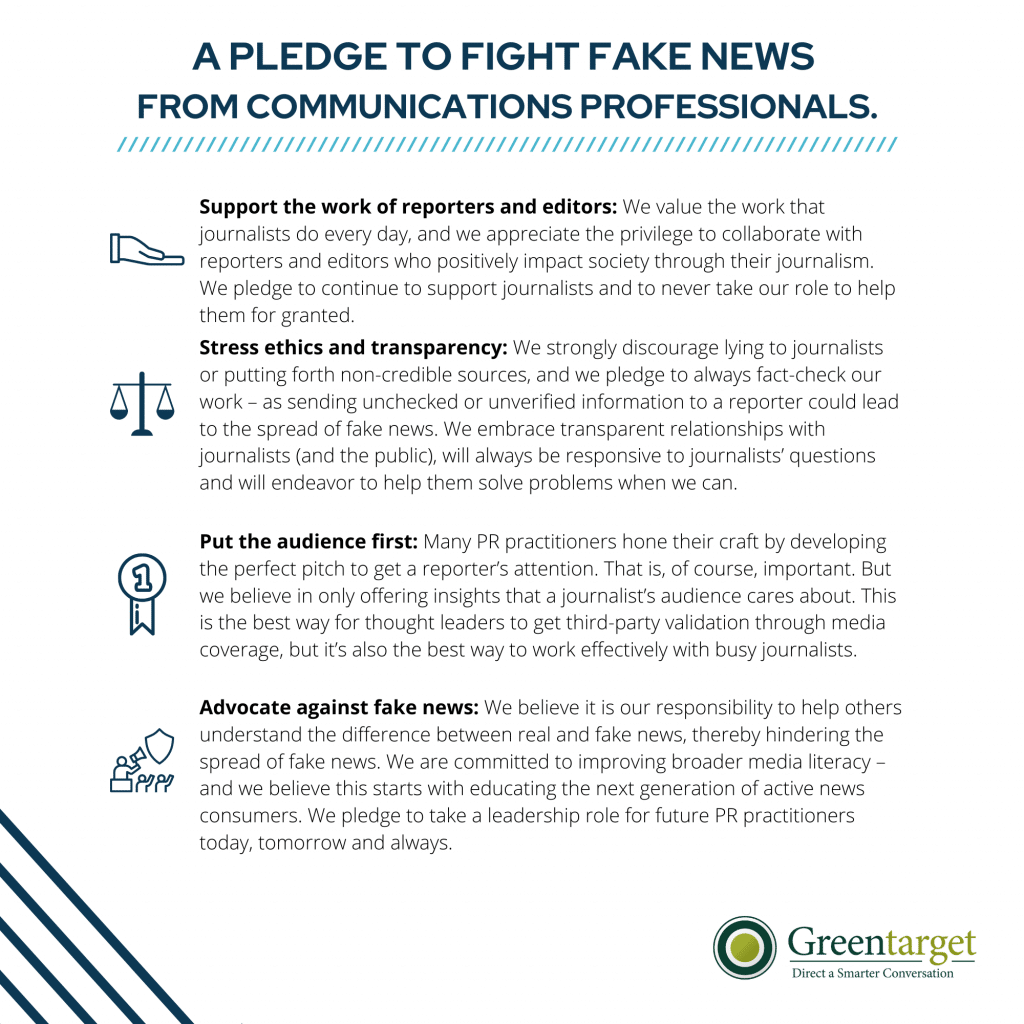
There are ways our industry can and should help. That’s why as part of the report and separately we’re releasing the pledge below as part of our commitment to fighting fake news – and we hope other PR professionals will abide by it as well.

Some of the pledge has been part of Greentarget’s ethos since our founding – and we believe our work to provide reporters with credible sources who can help make sense of what’s going on helps journalists regain the credibility that is essential to combatting fake news. But we’re choosing this moment to formalize our thinking – and we’re going a step further by committing to working toward broader media literacy. That includes working with a group of Chicago high school students in 2021 to help them understand the fundamentals of public relations – and how to identify fake news.

Our research report is indicative of our organization’s commitment and its evolving thinking. Journalists might feel like the responsibility of fighting fake news rests solely on their shoulders. But given the stakes – not only for our industry but, more importantly, for our democracy – it’s time for the PR industry to step up.

November 19, 2020 by Greentarget

How do you capture history as it happens? When the coronavirus pandemic’s full effects became clear in March, History Factory began its COVID-19 Corporate Memory Project to capture Corporate America’s reaction in real-time and provide insight into how other organizations are responding to the crisis.

In this episode of Authority Figures, host Aaron Schoenherr and History Factory Managing Director Jason Dressel discuss the COVID-19 Corporate Memory project, rising above the noise of standard thought leadership, and how every organization will have its COVID moment.

Aaron and Jason will discuss which organizations are communicating effectively during the pandemic. But they’ll also discuss how technology continues to change corporate history efforts. 

Episode Highlights

1:30 – Jason discusses his background and introduces History Factory.

2:31 – A deep dive into the COVID-19 Memory Project and what Jason and his team discovered.

5:49 – Aaron asks Jason to elaborate on the connection between authority and organizational responses to social issues.

7:16 – Challenges in creating the COVID-19 Memory Project and capturing the nation’s definitive moments as they happened. 

8:48 – Jason explains how an organization’s history supports its own notion of authority. 

10:25 – Examples of organizations that have exhibited authority amid the COVID-19 pandemic and social unrest. 

13:30 – Jason describes how every organization will have its “COVID moment.”

15:21 – The role digital archives played in creating the COVID-19 Memory Project. 

16:42 – How technology has impacted responses to 2020’s major events versus those of the past. 

17:39 – Jason reflects on the powerful impact a tangible document holds in a digital world and provides first-hand examples.

21:25 – Aaron and Jason discuss how organizations and leaders have effectively expressed authority in their actions.

Subscribe to Authority Figures on Apple Podcasts or wherever you get your podcasts.

November 5, 2020 by Betsy Hoag

It is time for business leaders to develop enlightened positions on social issues that are also authentic, constructive and on-brand for a new generation of ‘citizen consumers.’

To say that 2020 has been a challenging year would be a gross understatement. 

But the unprecedented chaos and confusion, our annus horribilis, has delivered a string of revelations for business leaders – revelations that will have lasting implications.

One of the most profound: Leaders in the private sector can no longer comfortably avoid taking an unambiguous and very public stance on what had been traditionally viewed as “social sector issues” such as climate change, racial injustice and economic disparity. 

The reason is simple enough yet – still – not widely accepted: Social challenges are business challenges. From the violent union struggles and workers’ strikes of the late 19th and early 20th centuries; to the Great Depression and Cold War eras; to the civil rights and women’s movements of the 1960s and 1970s; right up to the #MeToo and #BlackLivesMatter protests of the current day, business leaders have, time and again, been assigned a hard but necessary task, and that is to design strategies to respond to wide-scale social conflicts that impact those who produce and sell products and services as well as those who consume them – i.e., people.

There was a time when the C-suite grudgingly stepped up to meet an obligatory commitment to social responsibility simply to stay clear of bad publicity – and to keep the CEO out of the proverbial hot seat. But things have changed – dramatically. There are new, earnest expectations, articulated and memorialized by Business Roundtable in 2019, for businesses to true up on social responsibility in the belief that what is good for the planet and the society upon it is, in fact, good for business.

Therein lies another challenge for business leaders: How does a company effectively develop and communicate a position on key issues in a way that is constructive and not just reactive or performative? And is it even possible to do this while staying on-brand?  

Answering that question, nearly a decade after Michael E. Porter and Mark R. Kramer said CSR should be framed as a shared value that will deliver on unmet social needs, is more pertinent now than ever.

“I see this [conundrum] not as a dichotomy, but as a continuum with different poles,” said Caroline Grossman, executive director of the Rustandy Center for Social Sector Innovation at the University of Chicago Booth School of Business. “At one end, CSR is about positive impact on the planet’s most pressing problems, and at the other end it’s greenwashing. Risk mitigation falls somewhere in the middle.” 

Getting to a meaningful place on this spectrum is about asking questions, sometimes tough questions – the most interesting of which focus on understanding why this new approach to key issues is, actually, good business.

Drawing from the Past – and Other Industries

Companies, specifically C-suites within those companies, should incorporate key questions as a strategy exercise or strategy reorientation. 

This approach has become increasingly common across industries, said Grossman, whose research center supports people committed to helping solve complex social and environmental problems. “Some dramatic examples are companies founded on innovation that itself has the potential for outsize impact.”

Take plant-based meat. Grossman points out that Beyond Meat had a successful IPO last year and, as of this writing, is trading well above the offering price (even after a recent plunge). Impossible Foods, based on current research, is not planning an IPO but continues to attract investors. Both companies are also drawing attention from companies like Walmart, Kroger, Burger King and Amazon, and McDonald’s just announced a new “McPlant” line for 2021.

“I don’t think these retailers and restaurants stock plant-based meat because of CSR but because they think it is good business,” Grossman said.

Tables Have Turned

In the latter part of the last century, the most successful American corporations were uniquely positioned to drive consumer habits. One need only think of Nike, Google and Apple when it comes to what is now socially expected of us when it comes to deciding what athletic shoes we should wear, what email service we should use and what smartphones we should palm.

During the last six months, however, there has been a noticeable shift. After a ponderous and reactive response in the first weeks of the pandemic and then widespread protests, the social – social concerns, social issues, social anxieties – became a bigger influencer of big business. 

As a placard at a Black Lives Matter protest in Chicago this summer read: “no justice = no peace and no profit.” [Emphasis added.]

Ideally, however, business leaders are not acting solely out of financial self-interest. Recent events should be spurring them to consider the concept of social responsibility as a vital part of business – an essential, indeed intrinsic, component nested within any for-profit enterprise. 

Currently, there is strong support from consumers and investors for positive social/business impact. in Aflac’s 2019 CSR Survey, 82% of consumers said that companies bear responsibility for “making the world a better place,” ahead of the 75% who selected “making money for its shareholders.” Nearly all investors surveyed, unsurprisingly, placed importance on making money for shareholders (93%), but a similar portion of investors said that making the world a better place was important.

“I believe every business is inextricably linked to social responsibility. It is now part of our culture,” said Diane Primo, CEO of Purpose Brand Agency, an award-winning public relations, branding and digital marketing firm. “Even asset managers, investment bankers and financial giants are evaluating companies that do not comply with extensive ESG matrices.”

Primo’s insights reveal something else. Present-gen consumers have awakened to the fact that they hold real power – buying power – and they are quickly giving way to what will surely be a new demo for the 21st century: citizen consumer.

“What consumers care about, and how much they care, is redefining social responsibility,” Primo said. “Shared activism in combination with digital engagement is shifting culture quickly. We witness shifting perceptions as Black Lives Matter and COVID-19 spread and corporate responsibility evolves.”

This “evolution” was one of the reasons GreenHouse and Greentarget, in partnership with LAB/Amsterdam, launched Immediate Frontier. An independent research and innovation initiative, it was designed in part as a model for leaders to better see how to engage with the concept of CSR in a new, more holistic, less compartmentalized way. 

Some business leaders are ahead of the curve, Primo said.

“Public companies are already undergoing significant change,” she said. “As powerful consumer action groups team with investment groups to modify sales and reduce capital flows, change will happen – and quickly.”

X (and Boomers) Includes Y and Z Now

The fact that more leaders are willing to tackle issues that would not have seemed relevant to a for-profit entity’s business goals previously seems all the more natural, indeed necessary, as one contemplates another revelation: These social issues, now front and center, are leading the way to entirely new value propositions for corporations – and serving up impressive business outcomes.  

But present-gen leaders – Gen Xers and, in some cases, Boomers – shouldn’t bear this burden alone, nor are they capable of taking it on, experts suggest. Next-gen leaders deserve a seat at the table. 

Grossman, who teaches a CSR course at Booth, said young leaders take a long view and have sprung into action when it comes to the pandemic and helping Black-owned businesses.

“The next generation is demanding that business does things differently,” Grossman said. “[They’re] challenging leadership to take issues of diversity, equity and inclusion into account.”

Students are eager to jump in to think about social issues in a business context, and vice versa. And, Grossman said, the leaders at companies that sponsor the course at Booth are listening to fresh, new perspectives and straight-up challenges that students bring to the experience.  

“It’s critical for me to connect with all of [Rustandy’s] stakeholders – students, faculty, alumni, social sector practitioners and business leaders,” she said. “But it turns out that it’s the students who always ask the toughest questions.”

  • Page 1
  • Page 2
  • Page 3
  • Interim pages omitted …
  • Page 5
  • Go to Next Page »

Footer

Connect with us

To reach us by phone, call 312-252-4100.

close
  • We take your privacy seriously. We do not sell or share your data. We use it to enhance your experience with our site and to analyze the performance of our marketing efforts. To learn more, please see our Privacy Notice. Would you like to receive digital marketing insights in your inbox? We'll send you a few emails each month about our newest content, upcoming events, and new services.
  • Our Culture
  • Industries
  • Services
  • Insights
  • Our Manifesto
  • About Us
  • Contact Us
  • Privacy Notice
Close
Close