

October 14, 2026
Short Attention Spans Aren’t Hurting Your Content—Here’s What Is


Audiences aren’t necessarily losing their ability to pay attention. They’re becoming more selective about where they spend it.
Insights from University of Maryland professor Ronald Yaros suggest communications professionals should rethink how they structure content, measure engagement, and reach audiences who weren’t necessarily looking for them in the first place.
People have shorter attention spans now.
That’s an appealing explanation for what communications professionals confront every day as audiences scroll past carefully crafted thought leadership campaigns in seconds. But Ronald Yaros, associate professor of digital engagement at the University of Maryland’s Philip Merrill College of Journalism and director of its Digital Engagement Lab, challenged that premise during a recent media relations training session with Greentarget.
“If people really can’t pay attention anymore, how do we explain the enormous amount of time they willingly spend on sites like YouTube, TikTok, and Netflix?” he asked.
In his book The Digital Engagement Model, Yaros argues that the actual problem is how we’re designing information to earn that attention. His insights offer a unique perspective on how to compete in the modern attentional environment.
Here are three key takeaways.
1. Earn Attention in the First Few Seconds
Communicators spend a great deal of energy identifying their target audience, but Yaros argues even that leaves out two important variables: how much time someone has in the moment and whether they’re reading or merely scanning.
For instance, someone genuinely interested in an article might open it three minutes before a meeting and forget it by the time the meeting starts. You found your audience but still lost them.
Digital behavior rarely allows for the gradual build that traditional storytelling rewards. That makes the first few seconds critical. Yaros argues that value should be apparent almost immediately, through a persuasive visual, a human face, or a declarative headline that tells readers what they’ll get out of a given piece of content.
PR Takeaway: Ask what someone understands in the first few seconds of your content. If the answer is “not much yet, but keep reading,” restructure it with clear headlines, descriptive subheads, and scannable sections that give interested readers a path to go deeper.
2. Your Next Audience May Not Be Looking for You
Traditional audience strategy assumes some degree of existing interest, but on algorithmically driven platforms like LinkedIn or TikTok, users constantly encounter ideas they never searched for. Content designed for this “incidental audience” therefore needs to create what Yaros calls “situational interest.”
A general counsel might not wake up intending to research a niche regulatory issue, and a CFO may not be looking for commentary about an emerging litigation trend. But put the right insight in front of them, in a format that immediately communicates why it matters, and an incidental audience can become engaged.
Yaros’ framework for creating content with this reality in mind is SPICE: scannable, personalized, interactive, curiosity-inducing, and emotional. It’s unlikely your press release is going to contain all five variables, but SPICE is a useful pre-publication checklist.
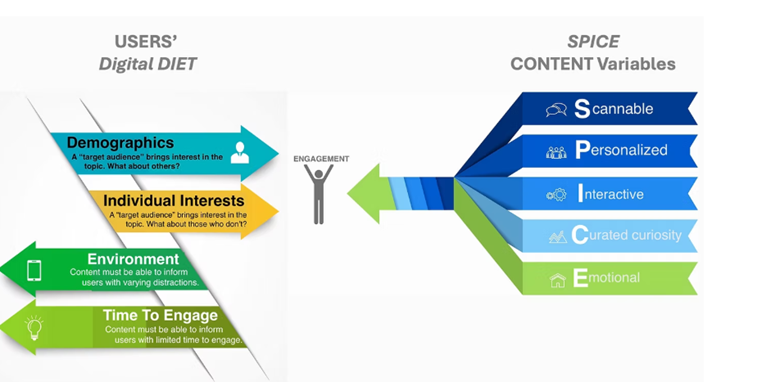
PR Takeaway: Ask: What would make someone who wasn’t looking for this stop and care? That may change your headline, the insight you present, the visual you use, or how you frame the relevance of an expert’s point of view.
3. Time Spent Isn’t the Same as Engagement
Communications professionals often treat time on page, clicks, likes, and shares as straightforward indicators of success, but Yaros draws an important distinction between interactivity and engagement.
In two of three experiments comparing a traditional story format with the interactive Smart Story Suite Yaros developed, participants spent less time with the Smart Story version but recalled more information than those using the traditional version.
Yaros attributes that result in part to “progressive disclosure,” an approach that allows people to choose which elements of a story they want to explore rather than forcing everyone through the same linear block of text.
In short, someone can like or share something without absorbing much of it; conversely, someone might quickly find exactly what they need and leave with a strong understanding of the message.
PR Takeaway: Don’t judge content by a single engagement metric. Pair quantitative measures such as time on page, click-throughs, and shares with measures that get closer to the actual communications objective, such as surveys that test whether the audience understood and remembered the idea.
Design Content for How People Actually Consume Information
Approaching content proactively for the digital age doesn’t mean abandoning journalism’s fundamentals. People will spend time with information when they believe the value warrants the investment—but convincing them of that may require reconsidering some familiar formats. Even something as conventional as a press release could benefit from more explanatory subheads and explicit statements that both communicate information and preview what comes next.
Credibility, expertise, relevance, and relationships will always matter—just don’t forget that the container does, too.
Related Posts
-

Challenge As the 2024 U.S. elections approached, global consulting firm BRG sought to showcase its…